
As a country in North-Eastern Europe, Estonia lies in the Baltic region. Besides, it is a part of the Schengen country, so its visa policies are similar to the Schengen rules.
Therefore, travelers need to get a visa first before traveling to Estonia. Depending on the visit purpose, different visa types such as work, tourism, and study visas can be used.
If you want to travel to this European country, read the following guide to learn the essentials of an Estonia visa from Pakistan.
Fun Facts about Estonia
The following fun facts about Estonia will help you enjoy your trip to the destination country.
- Globally, Estonia has the highest number of supermodels per capita
- Kuressaare, a famous place in Estonia, has more than 1,200 spa beds.
- Moreover, the people of Estonia are ranked as the third tallest people in the world.
- Furthermore, Estonia has a smaller population because half of the country’s land is covered in forest. This means that it is a habitat of other species.
- The country has an extensive collection of national folk songs. They are more than 133,000 in number.
- Lastly, one of the most important sports in Estonia is known as ‘Wife Carrying’. Here the male partner competes with other participants while carrying their female partner.
Is Estonia a Schengen country?
Yes. Estonia is a part of the Schengen Region. This means that if you get an Estonia visa from Pakistan, you can also travel to other neighboring countries without applying for a separate visa as this area has no internal border checks.
In addition, other Schengen member countries are Austria, Belgium, Bulgaria, Croatia, Czech Republic, Denmark, Finland, France, Germany, Greece, Hungary, Iceland, Italy, Latvia, Liechtenstein, Lithuania, Luxembourg, Malta, Netherlands, Norway, Poland, Portugal, Romania, Slovakia, Slovenia, Spain, Sweden and Switzerland.
Do Pakistani Citizens Need a Visa to Enter Estonia?
Yay. Pakistani citizens need a visa to travel to Estonia. This travel document is required to legally enter and stay in the target country. Moreover, it is mandatory for you as a Pakistani to have a visa because you are a citizen of a non-EEA/EU/Swiss country that does not have a visa-free regime with the Schengen Area.
Therefore, you can apply for a short-stay visa to stay for 90 days or a long-stay visa to stay in Estonia for one year.
Who does not need a visa?
The nationals of the following countries do not need a visa to travel and stay in Estonia.
- European Union (EU)
- European Economic Area (EEA)
- Switzerland
- Moreover, if you belong to a country that is in liberation with the Schengen Zone, you are not required to get a permit to enter Estonia. This includes the U.K., the USA, Australia, Japan, New Zealand, Canada, etc. They can travel to this Schengen country for up to 90 days within one hundred and eighty days. For longer stays, they must get a national visa.
Types of Estonian Visas
Depending on the occasion or your visit purpose to Estonia, you can use any of the following visa types.
| Visa type | Purpose | Duration of stay |
| Schengen visa | A Schengen visa allows you to travel to Estonia for short-term purposes including tourism and business. You can also visit other Schengen countries with a Schengen visa. | 90 days within 180 days |
| Transit visa | When traveling from Pakistan to a third country to transit in an Estonian airport, you will need a transit visa. Moreover, citizens of the EU/EEA/Swiss do not need a transit visa. | 48 to 72 hours |
| Work visa | A work visa allows you to travel to Estonia for work purposes. However, before applying for a work visa, your employer should register your job with the Estonian Police and Border Guard Board | Depends on the length of the employment contract. |
| Student visa | Pakistani students need to apply for a student visa to continue their studies in Estonia. For this purpose, an Estonian institute or university must grant you admission. | Varies depending on the duration of your academic course. |
| Family visa | A family visa allows you to join your family members or better half who live in Estonia. This also requires you to apply for a temporary residence permit. You can also work, study, or enjoy the same residency rights as your family members. | Up to one year. |
| Investment visa | An Estonian investment visa allows you to invest in a business in the host country. Other than that, you also need a temporary residence permit. | Valid for up to one to three years. |
| Digital nomad visa | A digital nomad visa allows freelancers to travel to Estonia and start working in their specialized fields. | 1- 2 years. |
| EU blue card visa | If you are a highly skilled professional having the right qualifications, you can travel to Estonia to do your job by applying for an EU blue card visa. | Four years or the duration of the employment contract. |
Important: Citizens of these third countries including Afghanistan, Bangladesh, Ghana, Iran, Iraq, Nigeria, Pakistan, Somalia, Democratic Republic of Congo, Eritrea, Ethiopia, and Sri Lanka need a transit visa to pass through one of the airports of the Schengen Area.
Schengen Visa Vs. National Visa
Before applying for a visa, it is essential to learn the difference between the two main categories of Schengen visas as explained below.
Schengen visa
- A Schengen visa is a short-stay visa, issued for up to ninety days.
- Moreover, you can use it for a short duration such as visits, tourism, business, etc.
- Lastly, with a Schengen visa, you cannot get a residence permit. Therefore, make sure to leave the country before your visa expires.
National visa
- On the other hand, a national visa is also known as a long-stay visa, issued for 365 days.
- Furthermore, a national visa allows you to travel to Estonia for work, study, family reunions, and business purposes.
- Last but not least, a Type D visa allows you to get a residence permit. Moreover, you can also extend your stay for an indefinite time.
Documents Required for an Estonia Visa from Pakistan
When applying for an Estonia visa from Pakistan, submit the following required documents.
Passport
Submit your passport with a validity period of at least three months ahead of your stay in Estonia with two blank pages.
Visa application form

Complete the visa application form by providing accurate information. Then, print it and put your signatures at the end.
Photographs
Two passport-size full-face photographs with a light color background and not older than the last six months should be submitted.
Previous visas
If you have been to any other Schengen country in the past, submit your previous visas.
Proof of accommodation

Documents showing that you have a place to stay in Estonia should be submitted. This may include a hotel reservation, a rental contract for an apartment or house, or an invitation letter.
Proof of flight reservation

Submitting proof of flight reservation shows that you have an intention of flying to the target country. The document demonstrates information such as your flight number, IATA codes, luggage weight, travel dates, and times.
Cover letter

Furthermore, writing a cover letter for a visa will help add strength to your application. For this purpose, you can include information such as the duration of your stay, the visit purpose, the intended activities, etc.
You can buy a well-crafted cover letter from travel experts at a minimal cost at coverletterforvisa.com.
Travel health insurance
Purchase a travel health insurance policy with a coverage amount of at least 30,000 euros valid for the entire stay in Estonia. This will help you bear unexpected medical and travel expenses including surgery, evacuation, repatriation, luggage, or passport loss.
Proof of financial means
Financial documents such as a bank statement issued by the bank to show that you can support yourself financially in Estonia should be submitted. It acts as proof that you have at least 100 euros per day to manage your transportation, food, and accommodation.
Proof of civil status
Documents showing your civil status such as a marriage certificate, birth certificate of your children, and death certificate of your spouse should also be submitted.
Visa Application Process When Traveling to Estonia from Pakistan
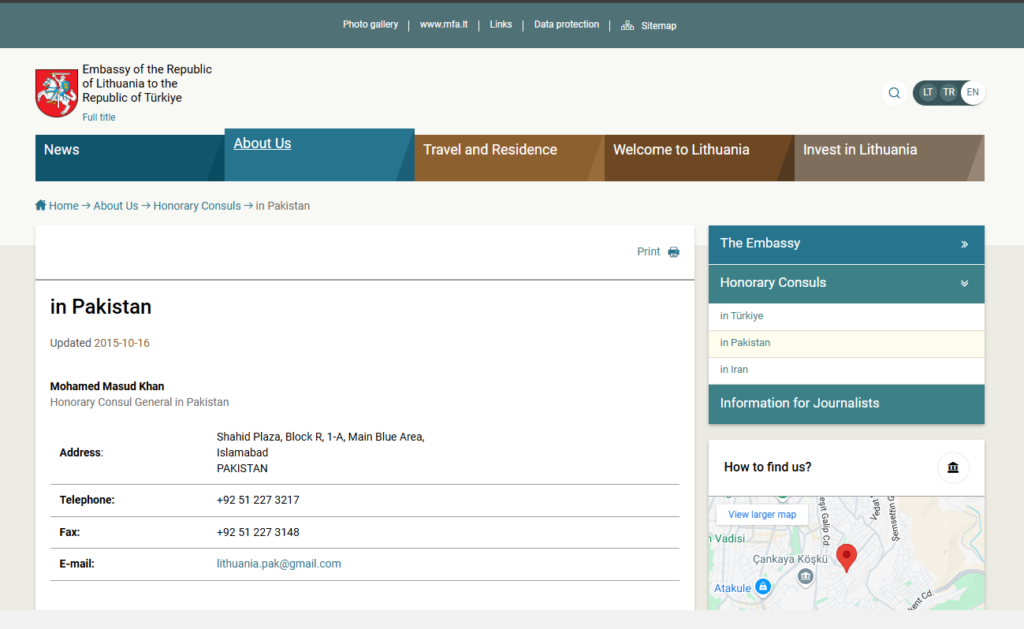
Pakistanis can only apply for a visa through the embassy or paper method. Unfortunately, Estonia has no embassy, consulate, or diplomatic mission in Pakistan. Therefore, you can either find another nearest Estonian Embassy such as located in India or an alternative such as the Lithuania Embassy in Pakistan to submit your application.
Besides, follow the steps highlighted below.
Step 1: Visit the Embassy of Estonia
Because Estonia has no mission in Pakistan, you can visit the Embassy of Lithuania in Islamabad, Pakistan, and schedule an appointment. This embassy represents Estonian interests and will handle your application.
Step 2: Complete the visa application form
The second step is to fill out the visa application form. For this purpose, you can either complete it online or download it from the given link. After that, print it and put your signatures at the end to submit it with the rest of the documents.
Step 3: Deposit the fee
Furthermore, you are supposed to pay the visa fee at the same embassy. Make sure to deposit the correct amount in local currency either in cash or through debit/credit card.
Step 4: Submit the documents
After translating all the documents into Estonian or English language, make sure to submit them to the embassy on the day of your appointment.
Step 5: Wait for the answer
Lastly, wait for the answer considering the processing time. The embassy will notify you about the result of your visa application either through SMS or Email.
Processing Time
Usually, the standard processing time for an Estonian visa is one to two months. Moreover, it depends on certain factors. For example, when you submit your documents, your specific case, and visa type.
Thus, it is important to complete all the steps to make sure that there are no delays in the response of your visa application.
Application Fee
During the submission of your documents at the nearest Embassy of Estonia, you also need to deposit the visa fee. Certain factors such as your visa type, home country, and age may affect the Estonia visa fees.
However, the standard fee structure is mentioned below.
- 90 euros or 26,601 PKR for a short-stay visa
- If a child under the age of 15 has applied for a Schengen visa, they must pay 45 euros or 13,300 PKR
- A long-stay visa requires you to pay 100 euros or 29,557 PKR
- 80 euros or 23,645 PKR if you apply for an airport transit visa
Estonia Visa Refusal
If the relevant embassy denies your Estonian visa application, you can,
- Appeal the decision within one month of your visa refusal by correcting the previous mistakes.
- Reapply for the same visa once again.
- Lastly, apply for a Schengen visa for another Schengen country and travel to Estonia.
Common visa rejection reasons
The following are some of the main reasons for a visa rejection.
- You have a criminal record
- Fake travel documents
- Damaged passport
- Missing or insufficient documents
- Inaccurate information on the visa application form
- Fail to provide proof of accommodation
Visa Extension
In case you want to reside in Estonia longer than the normal duration of three months, you can use any of the following methods.
- Apply for a long-stay visa as it allows you to live in the country for one year.
- Secondly, you can also apply for an extension of your Schengen visa. However, it is applicable only in rare conditions such as humanitarian reasons or political upheaval in your home country.
FAQs
- What is the validity period of an Estonian visa?
Depending on the visa type you have applied for, you can either stay for up to 90 days in Estonia with a short-stay visa or one year with a long-stay visa. To calculate your days, you can use an online calculator.
- Is it easy to get an Estonian visa from Pakistan?
Generally, Estonia is one of the easiest countries to grant applicants visas. However, this does not give you the freedom to break the rules. Therefore, make sure to fulfill all the visa requirements to get a permit to travel to the host country successfully.
- What is the purpose of a long-stay visa?
A long-stay visa, valid for up to twelve months, allows you to visit your destination Schengen country for study, work, family reunion, investment, or retirement purposes. You can also extend it or convert it into a temporary residence permit.
Read Also: Denmark Work Visa from Pakistan